From View From The Top, Issue #35
The 2026 Vintage
I’m told Perfect weather makes lazy wine. The easy years — endless sun, no frost, nothing testing the vines — make the forgettable bottles. The vines don’t have to work. The roots stay shallow.
The hard years make the wines worth keeping.
I’ve been lending and building through markets for over thirty years, and I’ve come to believe the same thing is true of equity and loan books. Investing has vintages. And after three issues on this topic as it has to do with lending — the stale marks, the workouts, the lessons we paid full price for — I want to tell you why I think the vintage being written right now may be the best of the cycle.
And almost nobody is saying this. Which is usually a good sign.
THE WEATHER REPORT
Look at the chart of the US Fed Funds rate over seventy years. You can read every lending vintage of my career in that one line.
I started in the early 1990s, when money still cost something. I built through the late-90s, through 2001 — when I watched institutional equity vanish in a fortnight — and through the run-up to 2008, when I sold everything a week before the world ended and learned how much of that timing was judgement and how much was luck.
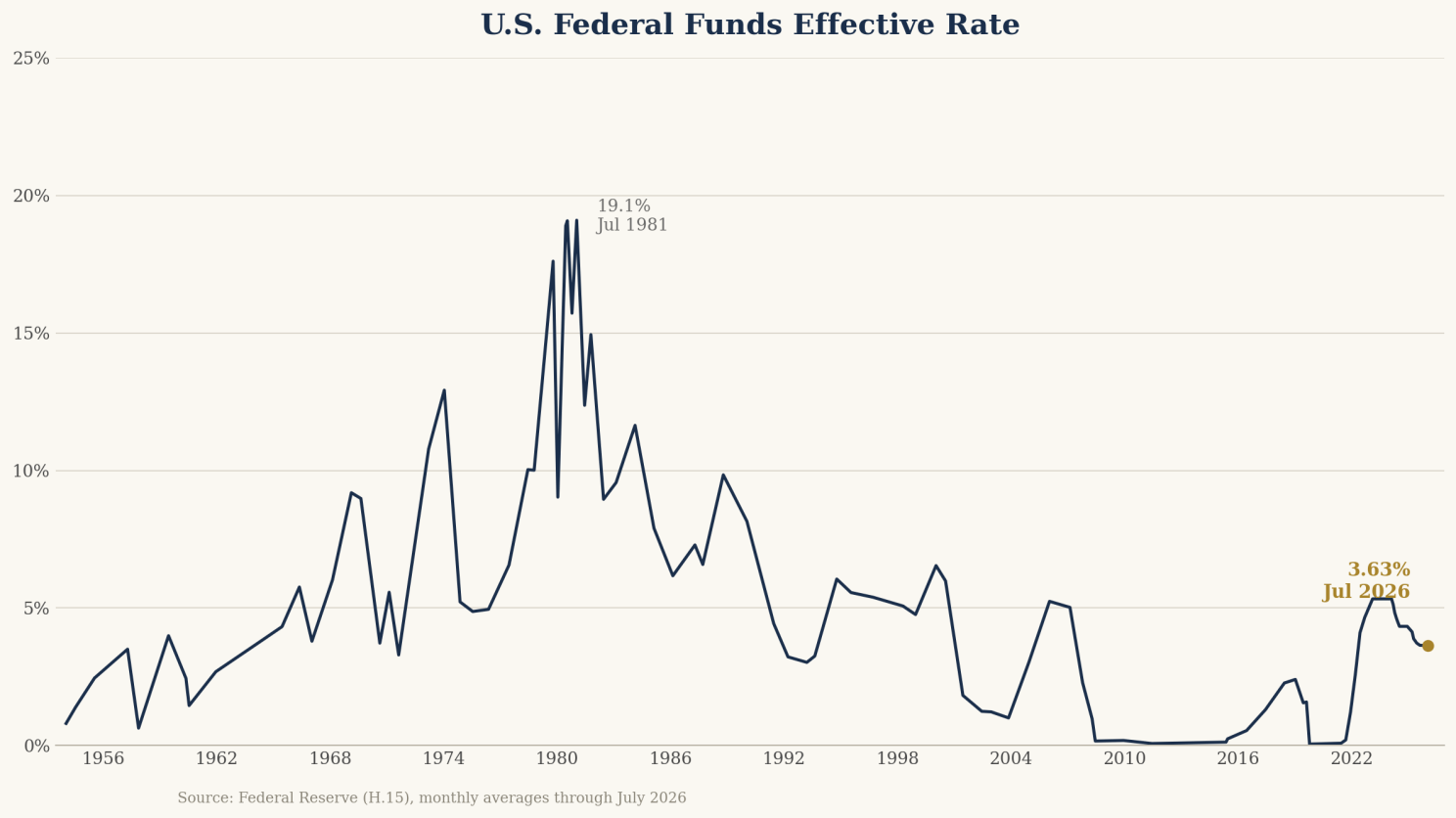
Then came the flat line. Zero rates from 2009. Zero again from 2020. The longest stretch of perfect weather in financial history.
I remember thinking, somewhere around 2019, that an entire generation of my industry had never priced money properly, they had never experienced cycles. They’d never had to. The weather did it for them. They rode the wave and had never experienced a fall out.
That weather produced the 2021 vintage — the most abundant harvest in lending history, and one of the worst.
Then the frost. Zero to over five per cent in eighteen months. Every assumption planted in the sunshine got tested in the cold. We tested a few of our own, as I told you two weeks ago.
Now look at where the line sits today. Rates down from the peak, but nowhere near zero. And not going back. The futures market says this is the climate now — not a heatwave, not a freeze. Just weather. The kind I grew up in.
I’m honestly relieved. Weather is what I know how to farm in. That’s always been my patch.
WHAT 2021 GOT WRONG
Let me be specific about why the 2021 vintage is drinking so badly — because every one of its flaws is something the loans we’re writing today don’t have.
Land bought at peak prices on the assumption of more appreciation. The entry basis was hope.
Valuations marked to momentum. Every appraisal had a rising market behind it and an incentive structure in front of it.
Contingencies sized for a world where nothing had gone wrong in a decade. I saw five per cent contingencies on two-year builds, priced at the bottom of the cost cycle. On our own troubled loan, the fixed price was signed by a contractor whose balance sheet couldn’t carry what came next. It went down and took the schedule with it.
And a generation of sponsors who had never operated through a correction. Not their fault. The weather had been perfect their entire careers. But there’s a difference between a developer who has read about 2008 and one who has lived through something like it, and in a workout you find out which one you lent to.
None of this was stupidity. It was climate. Bad timing. Perfect weather makes lazy underwriting — not because people are lazy, but because nothing in the environment punishes the shortcuts. I’ve watched it happen in three different decades on two different continents. It’s always the same.
WHAT’S GOING INTO THE 2026 VINTAGE
Now walk the same list with me today and let’s see what’s different. This is what I’m actually seeing across our pipeline — not theory.
The land.
Sites transacting at proper reset values — in some regional markets 20 to 30 per cent off peak, often from sellers who genuinely need to sell. The entry basis on a loan we write today is the most conservative I’ve seen in a decade.
The valuations.
As I wrote in Issue 29, the KPMG effect has pushed the whole valuation profession toward caution. A Red Book valuation dated 2026 is the most honest collateral number this market has produced in years. Nobody is marking optimism. When the base of your LTV is honest, everything you build on it is stronger.
The sponsors.
The tourists have left the vineyard. The developers still bringing us schemes in 2026 have survived the cost shock, the rate shock, and the funding drought — back to back to back. Their cost plans reflect real prices. Their equity is real, because the pretend equity got burned two years ago. When I sit across the table from a sponsor now, I’m looking at someone who has been stress-tested by the actual stress. You can’t buy that in due diligence. You can only find it after a correction.
The contracts.
Contractor pricing now includes a margin the contractor intends to survive on. The suicidally thin fixed prices of 2021 are gone — partly because the contractors who signed them are gone. And we now underwrite the contractor’s covenant as seriously as the borrower’s. Rule One from last week, applied at the front door. We learned that one the expensive way.
The contingencies.
Everyone now remembers that weather exists. The assumption set in one of our 2026 credit papers would have looked paranoid in 2021. It doesn’t look paranoid to me. It looks like memory.
The margin.
And here’s what makes this more than romance. The clearing banks are still gone. Several specialist lenders didn’t survive. Institutional capital is only starting to creep back. So the pricing on well-structured development credit is still wide — set during the drought. Better collateral, better sponsors, better contracts, at drought pricing. Risk down, return up.
In thirty years I’ve seen that combination maybe three times. It has never lasted.
WHY THE WINDOW CLOSES
Here’s what I know from having been through this before.
The capital comes flooding back. It’s already starting — I told you about the back leverage conversations a few weeks ago. As it returns, margins compress. As confidence returns, land firms up. As memory fades — and it always fades, faster than you’d believe — the contingencies thin out and the contracts tighten up.
The 2028 vintage will be grown in better weather. But it will be worse wine. By then the weather will have changed and the sunglasses will come out again.
I’ve watched this pattern my whole career: the best loans and equity investments are written when it feels worst, and the worst loans and equity investments are written when it feels best. The feeling is the problem. By the time lending feels comfortable again, the conditions that made it good are gone.
Sentiment is a lagging indicator of risk. Let me say that again; Sentiment is a lagging indicator of risk.
Which means the discipline isn’t just writing good loans now. It’s recognising that now is the anomaly — and moving while the weather still does half the underwriting for you.
WHAT WE ACTUALLY DO AT THE FRONT DOOR
None of this is a licence to lend into everything that moves. A good vintage still needs good winemaking. Here’s what discipline looks like on our desk right now.
-
We test the entry basis against distressed comparables, not just the valuation. If the loan only works at the Red Book number, it doesn’t work.
-
We underwrite the contractor like a borrower. Including the question I now ask on every deal: what happens on day 400 if this contractor goes down?
-
We size contingencies to survive a repeat of 2022. Not because 2022 repeats. Because something always does.
-
We back sponsors with scar tissue. A track record that includes the correction is worth more to me than a longer one that ends in 2021.
-
And we move fast — because in this market the best sponsors have choices again, and the lender who closes in four weeks gets the best fruit.
HARD LANDING
In wine, the verdict on a vintage arrives years after the harvest. The grower commits in the cold, on judgement, long before anyone can taste the result.
Lending is the same. The loans we’re writing in 2026 will report their returns in 2028 and 2029. When they do, the market will call it obvious. Of course that vintage outperformed. Reset land, honest valuations, surviving sponsors, real contingencies, wide margins. What else would it do?
But it isn’t obvious now. Now it looks like the worst market in forty years. Now the consensus is exhaustion. I’ve sat through the dinner conversations. I had one a few weeks ago with an investor who told me the market was finished.
That’s what a good vintage looks like from inside the growing season. I’ve seen enough of them to recognise the cold.
Hard years make the wines worth cellaring.
We’re in one. And we are looking to plant.